
Introduction
If you have had an email address for more than a decade, you have witnessed a silent, relentless war taking place right inside your inbox.
In the early days of the internet, receiving an email was an exciting event. You would hear that iconic "You've got mail!" sound, and you knew a friend or colleague had reached out. Today, for most people, opening their primary inbox is a source of stress. It is a daily chore of deleting, archiving, and filtering out garbage.
But the "garbage" has changed. The spam of yesterday is completely unrecognizable compared to the spam of today. What started as annoying but harmless digital flyers has mutated into sophisticated, weaponized psychological manipulation.
How did we get here? How did the internet's greatest communication tool become its biggest vulnerability? In this historical deep dive, we will track the evolution of spam from the 1990s to 2026, and explore why modern defense tactics like using disposable emails via TempMailM are no longer optional, but essential.
The 1990s: The Wild West and "Spray and Pray"
The term "spam" actually comes from a classic Monty Python comedy sketch where a choir of Vikings drowns out all other conversation by repeatedly singing the word "Spam" (referring to the canned meat). In the early 90s, early internet users adopted the term to describe mass, unwanted messages that drowned out real communication on early bulletin boards (Usenet).
The Tactics: In the 90s, bandwidth was low, and security was practically non-existent. Spammers used a tactic called "Spray and Pray." They would harvest millions of email addresses using basic web crawlers and send the exact same plain-text email to everyone.
The Content:
-
Chain Letters: "Forward this to 10 people or you will have bad luck for 7 years!"
-
Get Rich Quick: Basic multi-level marketing schemes and pyramid scams.
-
The Annoyance Level: High, but the Danger Level was relatively low. These emails were just digital junk mail. You deleted them and moved on.
The 2000s: The Golden Age of the "Nigerian Prince"
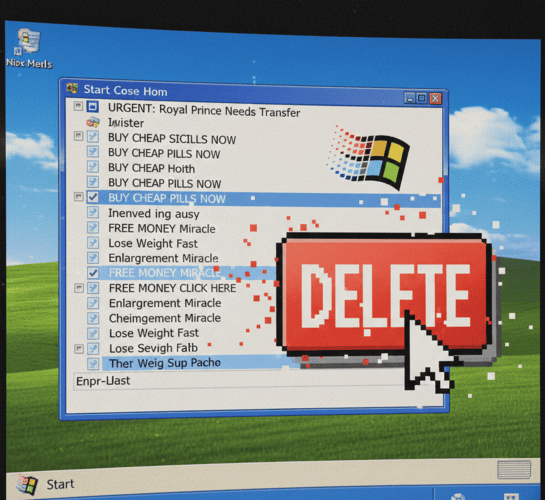
As the internet went mainstream, so did e-commerce. Money was flowing online, and criminals wanted a piece of it. This era birthed the classic "Advance-Fee Scam."
The Tactics: Spammers started using botnets (networks of infected computers) to send billions of emails a day. They relied on sheer volume. They knew 99.9% of people would delete the email, but they only needed 0.1% to fall for it. This era also saw the birth of the first real Spam Filters, forcing scammers to misspell words intentionally (e.g., "V1agra") to bypass early security algorithms.
The Content:
-
The Nigerian Prince: A wealthy foreigner needs your help to transfer millions of dollars, but you just need to send a small $500 fee first.
-
Fake Pharmaceuticals: Cheap, illegal medication sold via sketchy links.
-
Fake Lotteries: "Congratulations! You have won the Microsoft International Lottery!"
The 2010s: Data Brokers and "Legal" Spam
The launch of Web 2.0 and the explosion of social media changed everything. The internet shifted from an anonymous playground to an identity-driven marketplace.
The Tactics: The nature of spam shifted from illegal scams to aggressive, hyper-targeted Corporate Marketing. Big Tech companies and data brokers began harvesting your data. Every time you signed up for a service, bought a product, or clicked a "Terms of Service" box, your email was legally sold to third parties.
The Content:
-
Cart Abandonment Emails: "You left something behind! Come back and buy it."
-
Daily Deal Sites: The era of Groupon, where your inbox was flooded with 20 coupons a day.
-
The "Unsubscribe" Trap: Marketing emails became so overwhelming that users desperately clicked "Unsubscribe," which often just validated their email address and led to even more spam.
This was the era where the primary inbox truly died as a personal communication tool and became a cluttered shopping mall.
2020 to 2026: The Era of AI and Spear Phishing
Welcome to the present day. We have moved past simple annoyances and corporate marketing. We are now in the era of weaponized, AI-driven cyber warfare.
The Tactics: The "Spray and Pray" method is dead. Today, attackers use Spear Phishing. They don't send the same email to a million people; they use Artificial Intelligence (Large Language Models) to analyze massive data breaches. The AI looks at your leaked data, your social media, and your purchase history, and crafts an email specifically designed for you.
The Content:
-
CEO Fraud / BEC (Business Email Compromise): An email that looks exactly like it came from your boss, asking you to quickly pay an overdue invoice to a new bank account.
-
SaaS Impersonation: Perfect, pixel-for-pixel clones of Netflix, PayPal, or Amazon emails stating your account is locked and you need to log in (to a fake site) to fix it.
-
Zero-Click Malware: Highly sophisticated emails that can sometimes infect a device simply by rendering the HTML, without the user even clicking a link.
The Danger Level is now catastrophic. A single wrong click can result in stolen identity, drained bank accounts, or corporate ransomware attacks.
The Ultimate Defense: Breaking the Data Chain
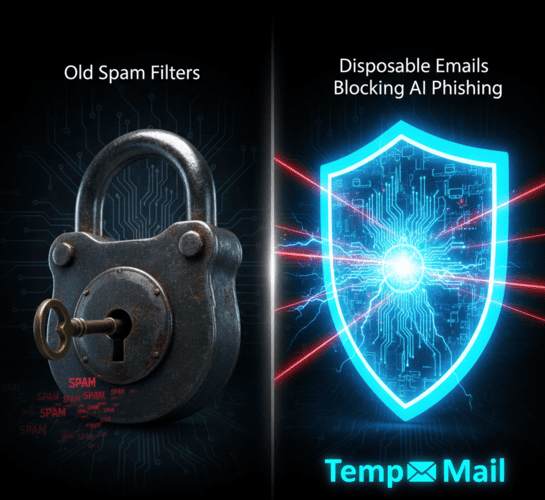
If AI and modern scammers are using our massive digital history against us, how do we fight back? Traditional spam filters are struggling to keep up with AI-generated perfection.
The only foolproof defense is Isolation. You must break the data chain.
This is exactly why disposable email services like TempMailM have become a mandatory tool for the modern web user.
-
Zero History: When you use a temporary email to sign up for a forum or download a file, that address has no history. There is no LinkedIn profile attached to it, no Amazon purchase history, and no boss's name for an AI to scrape.
-
The Dead End: If a database is breached and hackers steal a TempMailM address you used two years ago, it is useless. The inbox no longer exists. They cannot send a phishing attack to a ghost.
-
Protecting the Core: By using temporary emails for 90% of your daily internet activity, you keep your primary, permanent email address hidden. If the scammers don't know your real email, they cannot target it.
Conclusion: A War We Can Control
The evolution of spam is a reflection of the evolution of the internet itself. As technology became smarter, faster, and more integrated into our lives, so did the digital predators.
We can't go back to the 1990s. We can't stop marketers from wanting our data, and we can't stop AI from writing convincing phishing emails. But we can control what data we give them.
Treat your primary email address like your physical home address only give it to trusted friends and essential institutions. For the rest of the wild, evolving internet, generate a TempMailM shield. Let the bots and the spammers talk to a wall.