
Introduction
When we think of pollution, we visualize smoke pouring out of factory chimneys, plastic bottles floating in the ocean, or exhaust fumes from cars sitting in traffic. We rarely look at our smartphones and think of environmental damage. After all, the internet exists in the "Cloud," right? It’s invisible, weightless, and digital.
This is one of the greatest misconceptions of the modern era. The internet is incredibly physical. It is made up of millions of miles of underwater cables and massive, warehouse-sized Data Centers that run 24 hours a day, 7 days a week. And those data centers require an astronomical amount of electricity to operate and cool their servers.
Every single digital action you take every Google search, every Netflix stream, and every email you receive consumes electricity and generates a Carbon Footprint.
While streaming video takes up the most bandwidth, there is a silent, growing environmental disaster hiding in your inbox: Spam. In this article, we will explore the hidden ecological cost of promotional emails and explain how adopting a temporary email service like TempMailM is actually a powerful act of environmental conservation.
The Anatomy of a Digital Carbon Footprint
To understand the impact of an email, we need to look at the energy required to sustain it. According to researchers, an email is not just a few kilobytes of text; it is an energy-intensive process.
Here is the breakdown of an email's journey:
-
Creation: The marketer's server uses energy to generate and send the email.
-
Transmission: The email travels across network routers and switches, all consuming power.
-
Storage: This is the worst part. The email lands in your primary inbox (like Gmail or Yahoo). It sits on a physical hard drive in a massive data center. That hard drive spins, consumes electricity, and generates heat, requiring massive air conditioning systems to keep it from melting.
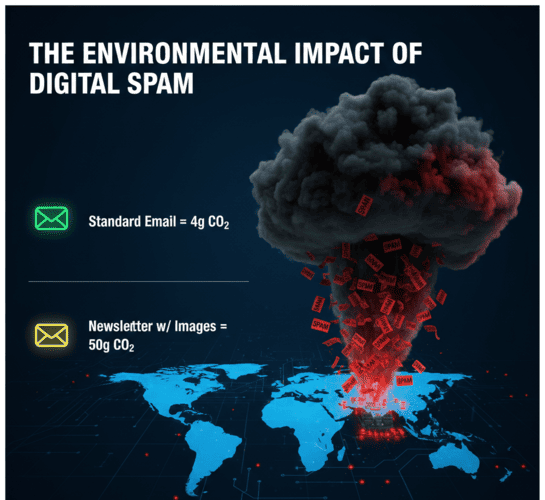
Researchers estimate that a standard text email emits about 4 grams of CO2. An email with a large attachment or heavy HTML images (like most marketing newsletters) can emit up to 50 grams of CO2.
Now, multiply that by the scale of the global spam industry.
The "Zombie Server" Epidemic
Currently, over 300 Billion emails are sent every single day worldwide. Cybersecurity firms estimate that nearly 45% to 50% of those are spam or unsolicited marketing emails.
Think about your own primary inbox. How many thousands of unread promotional emails from clothing stores, software companies, and flight booking sites are sitting there? You will never read them. You will never open them.
Yet, because they are stored in your permanent email account, Google or Microsoft must keep them alive forever. They sit on servers, continually drawing power, generating heat, and contributing to global carbon emissions. These are "Zombie Emails" living on "Zombie Servers." They serve absolutely no human purpose, yet they consume real-world resources.
If the global email system were a country, its electricity consumption would rank among the top nations in the world.
How Disposable Emails Fight Digital Pollution
This is where the architecture of a disposable email service becomes an environmental asset.
When you use your permanent email address to sign up for a 10% discount code at a store, you are inviting five years of weekly newsletters to be permanently stored on a server.
When you use a service like TempMailM to get that exact same discount code, the environmental outcome is completely different due to the Auto-Deletion Protocol.
1. The Power of Impermanence
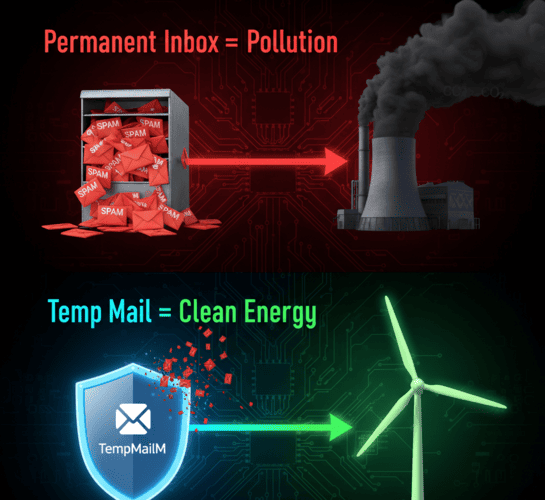
Disposable emails are designed to self-destruct. When you generate a temporary address, receive your discount code, and close the session, the inbox is wiped. The server permanently deletes the data. It does not sit in a "trash" folder for 30 days. It does not get backed up to an archive drive. It is gone. This immediately frees up server space and reduces the ongoing electricity required for storage.
2. The "Hard Bounce" Effect
What happens when the clothing store tries to send a "Flash Sale" email to that temporary address next week? Because the address no longer exists, the email bounces. It never reaches a storage server. The marketer's system receives an error and eventually removes the dead address from their mailing list. You have successfully stopped the generation of future digital waste at the source.
Digital Minimalism as Environmentalism
The concept of "Digital Decluttering" usually focuses on mental health and productivity. A clean inbox reduces stress and helps you focus.
However, in 2026, we must expand that definition. Digital decluttering is a form of environmentalism. Every gigabyte of data you prevent from being stored unnecessarily is a tiny fraction of a watt of electricity saved.
If millions of internet users adopted temporary emails for their low-value, transient web browsing, the compounding effect on global data center energy consumption would be massive. We could effectively shut down the "Zombie Servers" that do nothing but store unread spam.
Conclusion: A Greener Inbox
Protecting the environment doesn't always require massive lifestyle changes. Sometimes, it’s about making smarter micro-decisions.
You wouldn't leave the lights on in a room you never use. So why allow marketing companies to leave their data running on servers attached to your identity forever?
By using a disposable email service like TempMailM, you aren't just protecting your privacy and saving yourself from the annoyance of notifications. You are actively choosing not to contribute to the internet's hidden pollution problem.
Generate a temporary address, get what you need, let the data disappear, and keep the Cloud a little bit greener.