
Introduction
Your primary email address is your digital sanctuary. It is the central hub for your banking alerts, conversations with your boss, travel itineraries, and messages from family. It is arguably the most important piece of personal data you own on the internet.
Yet, most of us treat it like a cheap business card. We hand it out to any website that asks nicely, usually in exchange for a minor convenience a 10% discount, a free PDF, or 30 minutes of airport Wi-Fi.
This habit is exactly why the average inbox is drowning in thousands of unread promotional emails. Not all websites are created equal. While you absolutely must use your real email for your bank or tax portal, there is a vast, murky layer of the internet whose entire business model revolves around harvesting and monetizing your email address.
If you want to achieve "Inbox Zero" and protect your digital footprint in 2026, you must learn to identify these traps. Here are the 10 types of websites you should NEVER give your real email to, and why a disposable address from TempMailM is your only safe alternative.
1. Public Wi-Fi Portals (Airports, Cafes, Hotels)
The Trap: You select "Free_Airport_WiFi," and a captive portal pops up demanding your email before you can browse. The Reality: They aren't verifying your identity; they are collecting leads. These portals are notorious for selling your email to travel agencies, local businesses, and data brokers. Furthermore, public Wi-Fi is inherently insecure. If you type your real email on an unencrypted portal, a hacker in the same cafe could intercept it. The Fix: Generate a TempMailM address on your cellular data, paste it into the portal, get connected, and disappear.
2. Recipe and Cooking Blogs
The Trap: You just want to know how long to bake a lasagna. Suddenly, a massive pop-up blocks the ingredients: "Get my top 5 secret recipes! Enter your email!" The Reality: Food blogs are heavily monetized through affiliate marketing and ad networks. Once they have your email, you will receive daily newsletters, links to buy expensive blenders, and "partner offers" from companies you've never heard of. The Fix: Use a disposable email to get the recipe or the free meal plan, save it as a PDF, and close the tab.
3. Coupon and Promo Code Aggregators
The Trap: You are checking out on an e-commerce site and see a "Promo Code" box. You Google "Store Name Promo Code" and click on a coupon aggregator site. It says, "Enter your email to reveal this 20% off code!" The Reality: The code often doesn't even work. But now, the aggregator has your email and will relentlessly spam you with "Daily Deals" for stores you don't care about. The Fix: A temporary email gets you past the gate to see if the code is real, without sacrificing your inbox to deal-spam.
4. "Free" E-Book and Whitepaper Downloads
The Trap: A B2B software company or a life coach offers a "Free 50-Page Guide to Productivity." Just fill out the form. The Reality: This is classic "Lead Generation." You are immediately entered into an aggressive automated sales funnel. You will receive the PDF today, a follow-up tomorrow, a webinar invite on Wednesday, and a hard sales pitch on Friday. The Fix: Provide a TempMailM address. The automated system will send the PDF to your temporary inbox. Download it and let the subsequent sales pitches bounce off a deleted email address.

5. Online Petitions and Polling Sites
The Trap: You see a cause you care about on social media: "Sign this petition to save the local park!" The Reality: While some petition sites are noble, many are massive data-harvesting operations for political action committees and marketing firms. Once you sign, your email is categorized by your political/social leanings and sold to fundraisers. You will be asked for donations forever. The Fix: Support the cause using a burner email to register your vote without volunteering for a lifetime of political spam.
6. Real Estate and Apartment Hunting Portals
The Trap: You want to see the price history of a house on a real estate website, but it requires you to create an account. The Reality: Real estate agents are aggressive marketers. Even if you rent an apartment and stop looking, you will receive "New Listings in Your Area!" and mortgage rate updates for the next five years. The Fix: House hunting is temporary. Your email should be too. Use TempMailM for the browsing phase, and only give your real email to the specific agent you choose to hire.
7. Personality Quizzes and IQ Tests
The Trap: "Which Game of Thrones character are you? Enter your email to see your results!" The Reality: These are almost exclusively data-mining operations. Cambridge Analytica famously used personality quizzes to harvest massive amounts of psychological data. Do not feed these machines your primary identifier. The Fix: If you really must know if you are a Jon Snow or an Arya Stark, use a fake email generator to get the results.
8. News Websites with "Read 1 More Article" Paywalls
The Trap: You click a news link, but the site says, "You have reached your free article limit. Register with your email to keep reading." The Reality: They want to boost their "Registered User" metrics to show advertisers, and they will enroll you in their daily "Morning Briefing" newsletter, cluttering your morning routine. The Fix: Bypass the soft paywall instantly with a disposable email. Read the news, then close the tab.
9. Webinars and "Free Online Masterclasses"
The Trap: An influencer is hosting a "Free Live Training" on how to get rich, get fit, or find love. The Reality: It is rarely a live class; it is usually a pre-recorded, 45-minute sales pitch for a $1,000 course. By registering, you are opting into their highest-tier marketing list. The Fix: Get the webinar link using a temporary email. If the class is actually valuable, you can always buy the course later. But protect yourself from the aggressive follow-up sequence.
10. Sketchy Software and Gaming Forums
The Trap: You need a patch for an old video game or a niche piece of software. You find a forum that has the download link, but you must register to see it. The Reality: These forums have notoriously weak security. They get hacked constantly, and their user databases are dumped on the Dark Web. If you use your real email and a reused password here, you are inviting credential-stuffing attacks on your main accounts. The Fix: Never, ever use your primary email on an unverified forum. TempMailM is mandatory here.
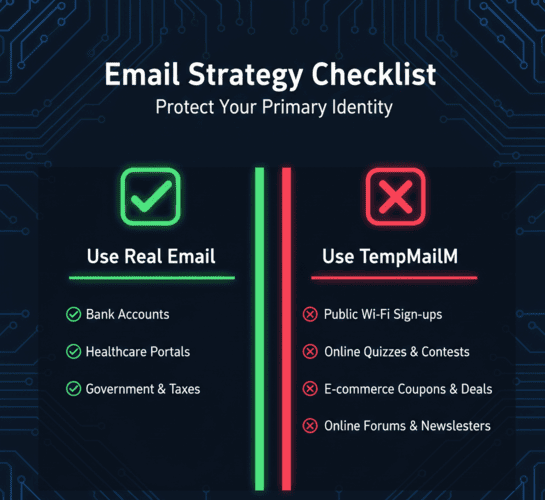
Conclusion: Be Ruthless with Your Inbox
Your primary email address is a VIP club. Stop letting anyone off the street walk right in.
Every time you encounter one of these 10 scenarios, take a three-second pause. Ask yourself: "Do I actually need to hear from this company next month?" If the answer is no, open a new tab, go to TempMailM.com, and generate a shield.
By identifying these traps and consistently using a disposable email, you will starve the data brokers, silence the marketers, and finally reclaim your digital peace of mind.